Showing posts with label stories. Show all posts

Thursday, January 24, 2013

Putting an End to Anger

by H. J. Ford for the story "The Comb and the Collar"

I want to share a sutra with you. It is the Discourse on the Five Ways of Putting an End to Anger, and I'm sharing it because it describes a process I have watched in myself. Maybe you will also find that you are practicing this already, or maybe you will be encouraged by what you hear. 

The full sutra is here, and it is relatively short. I think you will enjoy the story-like quality of the sutra. But if you want the short version, here is the fourth method:

"This is the fourth method, my friends. If there is someone whose words and bodily actions are not kind, and in whose heart there is nothing that can be called kindness, if you are angry with that person and you are wise, you need to find a way to meditate in order to put an end to your anger.

"My friends, suppose there is someone on a long journey who falls sick. He is alone and completely exhausted, and not near any village. He falls into despair, knowing that he will die before completing his journey. If at that point, someone comes along and sees this man’s situation, he immediately takes the man’s hand and leads him onward to the next village, where he takes care of him, treats his illness, and makes sure he has everything he needs by way of clothes, medicine, and food. Because of this compassion and loving kindness, the man’s life is saved. Just so, my friends, when you see someone whose words and bodily actions are not kind, and in whose heart there is nothing that can be called kindness, give rise to this thought: Someone whose words and bodily actions are not kind and in whose heart is nothing that can be called kindness, is someone who is undergoing great suffering. Unless they meet a good spiritual friend, there will be no chance for them to transform and go to realms of happiness. Thinking like this, you will be able to open your heart with love and compassion toward that person. You will be able to put an end to your anger and help that person. Someone who is wise should practice like this."
    —Discourse on the Five Ways of Putting an End to Anger


Thursday, June 7, 2012

Primary Speech

Walking in Sunrise, by Kristina Swarner
via Chemers Gallery

The concept of prayer has always been confusing to me. What does it mean to use a human language to speak to the divine? What could we possibly say to a divine being that would be of any consequence? For me, these are questions that I don't want an easy answer to.

Primary Speech, by Ann and Barry Ulanov, offered some new ground to explore on the subject of prayer. What I loved about their theology of prayer was where they located its beginning: the human desire to speak honestly about one's self. To me, this fits with the somewhat anthropological, psychological religion I'm drawn to. Don't we all, at times, want to be gently but firmly aware of who we are? 

From this point of "confession" comes illumination and unification—the identification with creation and awareness our interconnectedness. One of my favorite themes.

Although I think the Ulanovs would disagree, their concept of prayer feels like something that could be possible for people with vastly different concepts of God or no-God. To me, their minimal definition of prayer involves the meeting of self with a revelatory Other. 

"All that we would hold most dear and protect most earnestly is transmuted into our own bits of gold and frankincense and myrrh to bring to the child in us and the child outside us."

"We die to our own small versions of reality; we give into God's care our mythical gods and the gods of our personal and collective myths. These are the gifts we bring to our epiphany."
    —quotations from "Transfiguration," Primary Speech, by Ann and Barry Ulanov

Sunday, June 3, 2012

Spider Yoga

Spider Woman, by Man Ray

We moved into a new home about a month ago—a home that had sat empty for several years before we showed up. Spiders had decided to take up residence, and we still see a spider somewhere inside our home just about everyday.

When I see a spider, it isn't just a bug to me; I can't help think about the different roles that spiders have played in myths (grandmothers, seductive women, cursed humans, tricksters). I feel a little less powerful (and less mythological—there aren't any stories about me in mythology, are there?) when my path crosses these little guys. Sometimes they get smashed, I have to admit, but I try to let them be, when I can.

The other night a spider joined me for yoga. She had long thread-like legs, and she mostly walked upside-down on the window blinds. I found her to be a very good teacher. She was so graceful and so self-assured. 

So I tried to do spider yoga in her honor. This involved some balancing poses: sun salutations flowing into half-moon posewarrior three, and extended hand to big toe pose. With my arms and legs splayed out and floating in air, I tried to find the same quiet ease as the spider displayed. For me, this is when yoga is best—I'm not only deepening into my own breath and body, I'm also deepening into the mythological collective. 

Sunday, May 13, 2012

Personal Myth: Humans

Humans, by me
Humans, by me

Here is my next chapter in my personal myth project, which explores what it means to be human in this world. For me, what's interesting about being a humans is how language, laughter, and story can be used to   mediate the natural cycles of life and death. Given that I love learning foreign languages, I really feel that language is an integral part of the human experience. Maybe it's because I feel that words fail me too often, and that stories uplift me, but my own experience of the world is closely related to the human faculty for language and for nonlanguage too.

Sunday, April 29, 2012

The Stories We Tell Ourselves

by J. J. Granville
via Little Hokum Rag

"Why do you look at the speck of sawdust in your brother's eye and pay no attention to the plank in your own eye?"
    —Matthew 7:3

Lately I've been thinking a lot about stories we tell ourselves, and the verse above keeps popping into my head. I feel like it has beautiful applicability to current postmodern concepts of personal narratives. 

There are times when I don't enjoy the stories other people tell about themselves. The stories seem so detached from the reality that I'm seeing. But then I remember that the stories I tell about myself are just as strange and unfathomable. So what can I do?

Surely there is a way to be gentle and loving that shows our friends the unexplored sides to the stories they tell. It probably doesn't do much good to get indignant about little mythologies (unless they're tending towards weirdo, evil delusions), because for the person who's telling them, these mythologies are true. If we are craving gentleness from others, it seems only kind to be gentle with others' stories.

And maybe we can open our own life story up to the contributing views of others. What do you think? Is it possible to allow someone else to share in the authorship of your life?

Friday, April 6, 2012

Which Color Do You See?

Jungla n.1, Carnovsky
via A Daily Riot

Jungla n.1 in blue light

This art is such a great metaphor for how we go through life. We all have our own filters that show only part of the story. Not that filtering is a bad thing; how else will you arrive at a narrative and meaning? But if the narrative isn't working for you, don't forget that you can change it!

Tuesday, April 3, 2012

Personal Myth: The World

Here are is the second part to my series on my personal myth. You can see the first here.

I've been hesitating to continue posting my personal myth series, first of all because it is personal, and second of all because my art is going through some transformation and it feels strange to post something that would look completely different if I were to make it today. But, regardless, I want to share.

In "The World," I'm trying to think about what it means that the world is the way it is—that there are sentient beings, that there is life and death—and how humans fit into that narrative.

The World, by me

The World, by me

Sunday, November 20, 2011

Playful Songs

Western Meadowlark, by Adam Grimm

Did you know that some cultures consider the meadowlark to be capable of human speech? 

Arapaho mothers would feed their children meadowlark meat or eggs for four days and say certain prayers to give their children the gift of eloquence.

But meadowlarks are also thought to say mocking or dirty things! The bird that creates great orators is itself a joker. 


May our speech by playful, wise, and fearless.

Sunday, November 13, 2011

Gold Beneath the Clay

I just heard the story of the golden buddha today. Have you heard this story?

Here's the short version:

A clay buddha started to develop cracks. One Thai monk felt compelled to look inside the cracks with a flashlight to see what how it was made. To his surprise, the statue was gold! It had been covered by layers of clay years ago to protect it from looters, and all who knew this had been killed.

Buddha at Wat Traimit, via Thailand's world

The woman who told me this story talked about the layers that we put on to protect our golden nature. In some ways, these layers are an inevitable fact of being human, but in other ways, these layers prevent us from sharing our selves.

How might our layer of clay be softened, so that the gold below can shine through?

Sunday, October 16, 2011

Personal Myth: Creation

As you may have noticed, I'm working on a personal myth project. The idea is to write and draw a sort of true-fiction that reflects how I engage with the world. This may sound super new-agey, but consider a great book like Cosmicomics by Italo Calvino or even the great Star Wars. I really respect artists who take universal questions and engage with them in their own way.

Anyway, my project started with a series of four mandala-style drawings and an illuminated text to go with each. I've been calling the four themes "creation," "animals," "humans," and "heart." 


In "creation," I try to think about what the creation of the world means to me. I was inspired a bit by the philosophy of Gilles Deleuze and my husband's explanation of scientific theories. 

Creation, by the Dancing Alchemist

Creation, by the Dancing Alchemist


If you had to re-tell the story of creation, how would you tell it? 

Sunday, October 9, 2011

Sacred Space: Cabezon/Tsenajin

Cabezon/Tsenajin, taken by me

Cabezon Peak, as it is usually called by New Mexicans these days, is featured in the mythologies and cultures of the people native to the region. You can see it as you drive on highway 550, and you can hike it if you choose.

The Navahos call the peak "Tsenajin." For them, it is the head of the Big Giant Ye'iitsoh, who was killed by the twins Child Born of Water and Monster Slayer. When the giant died, his blood became the black rocks around Mount Taylor. This mountain marks the eastern boundary of the Navaho world.

Thanks to the twins, many people were saved from being eaten by the giant, and they were able to do this by the help of a variety of important figures, including their father, the Sun. The Sun was also father of the giant, making the twins and the giant brothers. 

What I love about this story is that even the "evil" character is intimately related to the heroes. I appreciate world views that accept evil as a part of the world, rather than as a wholly Other force. 

What I love about the place is that it is so physically connected to the story. (I can't think of any place that has such historical/cultural/religious significance. Except maybe for Jerusalem. But that is very far away and not part of my daily experience.) How would your life change if you had stories for the most beautiful, mysterious features of your world? What places would you choose to mythologize?

See the excellent full epic Dine Bahane for the story, or visit Voyage to Another Universe, Day 7 for a summary. You can also see a interdisciplinary master's project on the area here.

Friday, September 9, 2011

Fox Rain

I came across this beautiful illustration by Jeeyon Shim of Ink and Ginger/Jeeyon Makes.

Fox Apples, by Jeeyon Shim

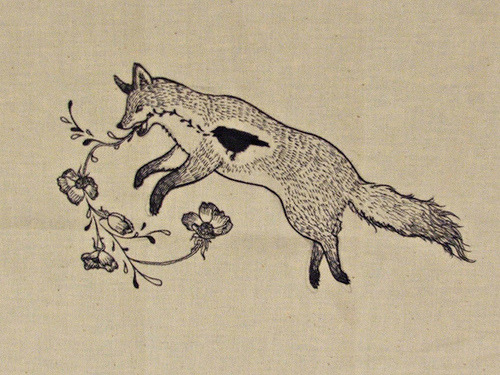
The illustration was inspired traditional Korean stories, where foxes are often trickster figures. There is even an expression, "fox rain" (여우비), which is used to describe sun showers.


Fox Tale, by Rupal Pearl

One important fox in Korean mythology is the gumiho (many-tailed fox; 구미호), who often takes the form of a beautiful young woman and seduces men. Some of the stories are told to warn men of femme fetales, but I love that women could be seen as dangerous tricksters. Maybe this is because I'm always trying to be good . . . sometimes the good needs to be balanced with a little more wildness.


Birthday Present, by J. Shim

Wednesday, September 7, 2011

Poetree

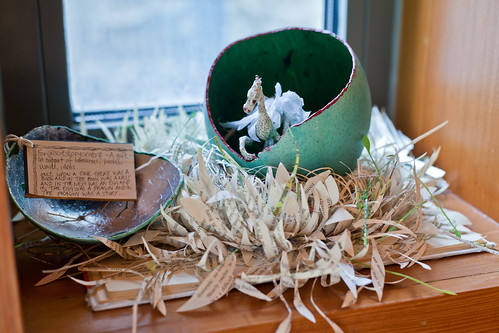
Continuing yesterday's theme on the magical world of words . . . Have you heard about the mysterious paper sculptures that have been left in various locations around Edinburgh? I just did, and the mysterious appearances have been continuing on for months!

The artist has been leaving them at locations that support "libraries, books, words, ideas," such as the Scottish Poetry Library, the Scottish Storytelling Center, and the Central Lending Library.

The "poetree" was left at the Scottish Poetry Library, with the note: "It started with your name @byleaveswelive and became a tree . . . We know that a library is so much more than a building full of books . . . a book is so much more than pages full of words . . . This is for you in support of libraries, books, words, ideas . . . a gesture (poetic maybe?)
Poetree, by Mysterious Book Sculptor with a Heart of Gold
Photographed by chrisdonia

My other favorite is the one that was left at the Scottish Storytelling Center, with the note: "For @scotstorycenter - A gift in support of libraries, books, works, ideas . . . Once upon a time there was a book and in the book was a nest and in the nest was an egg and in the egg was a dragon and in the dragon was a story . . .
Poetree, by Mysterious Book Sculptor with a Heart of Gold
Photographed by chrisdonia

For more pictures, visit Central Stn, where I first heard about these works of art.

Sunday, August 28, 2011

Composing a Life

What would it take to see our lives as art, slowly being assembled and improvised into a harmonious composition?

Sampler Quilt, via Pins and Thimbles

"We see achievement as purposeful and monolithic, like the sculpting of a massive tree trunk that has first to be brought from a forest and then shaped by a long labor to assert the artist's vision, rather than something crafted from odds and ends, like a patchwork quilt, and lovingly used to warm different nights and bodies."
    —Mary Catherine Bateson, Composing a Life, page 4

Friday, August 26, 2011

Unseen Bestiary

Looking forward to Lindsey Carr's drawings over at the Unseen Bestiary. Her work is truly magical! 

The Procession, by Lindsey Carr
Visit her blog to see more.

Natural Dark, by Lindsey Carr


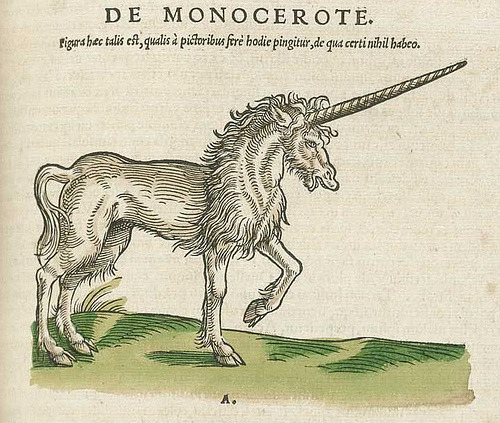
What I love about bestiaries is that they show a fundamental relationship between humans and the world. Who could hear about or see a magnificent creature for the first time (for example, the buffalo of North America) and not create a whole mythology around it? 

by Conrad Gesner, via Mon Cabinet de Curiosites

Leafy Sea Dragon, by William Beulow Gould, via the Book of Barely Imagined Beings


Thursday, August 25, 2011

The Trickster Felix Bush

I just watched Get Low, and I know I'll be thinking about it for days to come. While it wasn't quite the comedy I wanted it to be, it was much more.

It's the story of the recluse Felix Bush (Robert Duvall), and the mystery of why he chose to live alone for forty years. He holds a "funeral party" (with Bill Murray as the funeral director), and this becomes the means whereby his past is slowly revealed. It was a lovely testament to human life: the stories we tell, the choices we make, and the humor and tragedy in it all.


The character of Felix (Robert Duvall) is a bit of a trickster: as a recluse he is able to do things ordinary people couldn't, like hold a funeral for himself, and he shows how categories of good and evil don't necessarily capture the messy events of human life.


"We like to think that good and bad, and right and wrong, are miles apart. But the truth is, very often, they are all tangled up with each other."


Friday, August 19, 2011

The Magical Art of R. C. Gorman

As you may have noticed from the pictures in my post on chili, I'm a fan of R. C. Gorman's art.

I particularly his nighttime scenes. For one thing, the colors are sublime.
Crystal, by R. C. Gorman

Gracias, by R. C. Gorman

His nighttime scenes also serve as a reminder of the wisdom that comes from stories and dreams.

Night Stories, by R. C. Gorman

Dream Night, by R. C. Gorman


What about you? What nighttime stories did you listen to growing up? What stories will you pass on to your family?

Wednesday, August 3, 2011

Living in the Stream of History


Pshan-Shaw, Sweet-Scented Grass, by George Catlin

“That’s what history is… women writing letters, old men telling stories. Young women dying. New lives, new places. . . . You can’t choose the times you live in. You can only try to change them a little bit.”
    —Levi Zendt, from the miniseries production of Jame's Michener's Centennial


Each period of history has its own challenges. Its seems like some of ours include holding civil conversation, being willing to compromise, living within the planet's needs. . .

What types of change do you want to see? How can you be that change?

LinkWithin

Related Posts Plugin for WordPress, Blogger...