Showing posts with label poetry. Show all posts

Thursday, October 18, 2012

Nature's Course

Daphne mezereum with butterfly, by Georg Dionysus Ehret
via Victoria and Albert Museum

The flower invites the butterfly with no-mind;
The butterfly visits the flower with no-mind.
The flower opens, the butterfly comes;
The butterfly comes, the flower opens.
I don't know others,
Others don't know me.
By not-knowing we follow nature's course.
    —from Dewdrops on a Lotus Leaf, by Ryokan, translated by John Stevens, via gardendigest

This Zen poem has come up in several contexts lately, and along with a conversation on Derrida and his concept of waiting for the revelatory presence of the Other, it has me thinking some about the mysterious, unfathomable depth of things.

It's a favorite topic of mine; I seem to find the theme in a variety of places—Italo Calvino's writings, for example. The mysterious Other has such potential for ethics and art. Accepting the Other as mysterious leaves space for authentic encounters to occur. And, when the concept is combined either with a scientific or Taoist/holistic perspective, the face of the Other shifts. That mysterious Other that seems to completely separate from me becomes a part of me. 

Sunday, September 23, 2012

What I Wanted to Say

Letter to Emile Bernard from Paul Cezanne
via the Coutrauld Art Institute

"So here I am, in the middle way, having had twenty years—
Twenty years largely wasted, the years of l'entre deux guerres
Trying to learn to use words, and every attempt
Is a wholly new start, and a different kind of failure
Because one has only learnt to get the better of words
For the thing one no longer has to say, or the way in which
One is no longer disposed to say it. And so each venture
Is a new beginning, a raid on the inarticulate
With shabby equipment always deteriorating
In the general mess of imprecision of feeling,
Undisciplined squads of emotion. And what there is to conquer
By strength and submission, has already been discovered
Once or twice, or several times, by men whom one cannot hope
To emulate—but there is no competition—
There is only the fight to recover what has been lost
And found and lost again and again: and now, under conditions
That seem unpropitious. But perhaps neither gain nor loss.
For us, there is only the trying. The rest is not our business."
    —"East Coker," by T. S. Eliot, via even*cleveland

Lately I've been feeling that the art of communication is far beyond me, perhaps because for me,  communication really does look like a form of poetry. Maybe I've been thinking too much about Zen masters like Dogen, who could use words to teach such all-encompassing truths with such brevity and clarity. Or, on the less happy side, maybe I've been thinking too much about human failures of communication, in the realm of politics, or in the realm of families. Sometimes simply communicating seems like the most difficult poetry of all, and yet, all we can do is try.

Thursday, August 16, 2012

Stars and Aims

Libra, by Mikalojus Ciurlionis
from his Zodiac Cycle


"I feel my fate; my fate finds me.
I feel my star; my star finds me.
I feel my aims; my aims find me.
My soul and the world are one. . . .

Life will be clearer around me.
Life will be more burdensome for me.
Life will be richer for me."
    —excerpt from "The wishes of the soul are springing," by Rudolph Steiner


I've been feeling lots of uncertainty lately. My job, which inevitably grounds my day, is in the midst of change,  but what kind of change I truly cannot say. I find myself becoming resolved to find my way, to find an anchor and not let life cast me about, if that's not my choosing. I feel like if I work hard enough, the anchor will find me. Not that the anchor will make life any easier, but I think the sensation of grounding above chaotic waves will feel sweet and victorious.

Thursday, August 2, 2012

Language Celestial

Vision, by Katie Scott
via The Idea Foundation

O thou Spirit of Truth, visit our minds once more,
Give us to read in letters of light the language celestial
Written all over the earth, written all over the sky—
Thus may we bring our hearts once more to know our Creator,
Seeing in all things around, types of the Infinite Mind.
    —from "Correspondences," by Christopher Pearce Cranch


When I read this poetic excerpt, I perform a creative misreading in which "Creator" becomes "Creative Ground of Being" and "Infinite Mind" becomes "Infinite Mind-Body." I've had lots of practice hearing my own heretical revisions in my years of church going. I like to think of this process of willful misunderstanding  as recycling worn material for my own use. 

Do you ever imagine what your version of the "Creative Ground of Being" looks like? Would it be the famous giant eyeball? For me, I like to think it has the particular smell of a garden after rain. I rarely seem to break my imagination away from the earth and into the stars.

Thursday, June 14, 2012

Living with Poems

Illuminated Manuscript, by Sarah Cain
via Bryan Miller Gallery

I've been thinking about what poems I might like to carry around in me, memorized, to take refuge in when necessary. Already, my list of poems far outstrips the time I'm willing to put in to such a project. After making this list of future poems I will have in my head some day, I thought of one that I've already been living with for a decade now. I still don't have it memorized, but I am always returning to it. I think I first read this poem because my dad pointed it out to me in some publication (maybe the daily newspaper?), so it's always felt a little bit like a gift--something that I should appreciate and take care not to lose. 

And then there was St Kevin and the blackbird. 
The saint is kneeling, arms stretched out, inside
His cell, but the cell is narrow, so

One turned-up palm is out the window, stiff
As a crossbeam, when a blackbird lands and
Lays in it and settles down to nest.

Kevin feels the warm eggs, the small breast, the tucked
Neat head and claws and, finding himself linked
Into the network of eternal life,

Is moved to pity: now he must hold his hand
Like a branch out in the sun and rain for weeks
Until the young are hatched and fledged and flown.

 *

And since the whole thing's imagined anyhow,
Imagine being Kevin. Which is he?
Self-forgetful or in agony all the time

From the neck on out down through his hurting forearms?
Are his fingers sleeping? Does he still feel his knees?
Or has the shut-eyed blank of underearth

Crept up through him? Is there distance in his head?
Alone and mirrored clear in Love's deep river,
'To labour and not to seek reward,' he prays,

A prayer his body makes entirely
For he has forgotten self, forgotten bird
And on the riverbank forgotten the river's name.

    —"Saint Kevin and the Blackbird," by Seamus Heaney

Sunday, May 20, 2012

Love Moves Us All

Marine bleue, Effet de vagues, by Georges Lacombe

I've been doing some house cleaning, and I came across an old program from a concert of classical music and poetry readings by Robert Pinsky. Flipping through the poems, I noticed several had stars marked next to them. This is one of them: 

As when far off in the middle of the ocean
A breast-shaped curve of wave begins to whiten
And rise above the surgace, then rolling on
Gathers and gathers until is reaches land
Huge as amountain and crashes among the rocks
With a prodigious roar, and what was deep
Comes churning up from the bottom in mighty swirls 
Of sunken sand and living things and water—

So in the springtime every race of people
And all the creatures on earth or in the water,
Wild animals and flocks and all the birds
In all their painted colors, all rush to charge
Into the fire that burns them: love moves them all.

    —"The Wave," from Georgics, book III, by Virgil, translated by Robert Pinsky

Tuesday, March 13, 2012

The Gods Speak of God

by Stephen Mackey

I'd been thinking about God and I'd been thinking about poetry, and then this poem appeared:

It doesn't interest me if there is one God 
or many gods. 
I want to know if you belong 
or feel abandoned. 
If you know despair or can see it in others. 
I want to know if you are prepared to live in the world 
with its harsh need 
to change you. If you can look back 
with firm eyes 
saying this is where I stand. I want to know 
if you know 
how to melt into that fierce heat of living 
falling toward 
the center of your longing. I want to know 
if you are willing 
to live, day by day, with the consequence of love 
and the bitter 
unwanted passion of your sure defeat. 

I have heard, in that fierce embrace, even 
the gods speak of God. 

    —"Self Portrait," by David Whyte  


(I've posted a bit on David Whyte before, when I talked about Irene Belknap's art, so I guess I'm a fan, although every time I encounter his work I think it's the first time I've discovered him. What a wonderful feeling, to keep discovering someone I like.)

When I was thinking about God, I was wondering if I could verbalize what I believed to anyone, and if that someone could accept what I said without needing to hear her own view reflected back to her. So this poem affirms something that I feel deeply, that the question of God isn't as important as all that gets tied up with God, and that God is a word that means something more than God. Thank goodness for poets and poetry; I always feel so relieved to find someone who can artfully say what I feel.

Saturday, December 17, 2011

A Poet Speaking through the Piano

Swedish Bonad
via Cupboards and Roses

Can you imagine what it would be like to lose your ability to speak? Now imagine if you could use music to regain some of your means of communication.

Tomas Tranströmer, a Swedish poet, was awarded the Nobel Prize, but because of a stroke, he was unable to give an acceptance speech. Instead, his poetry was set to music. I wish I could find a video somewhere . . .

At least I've been able to find some of his poetry, which I really like.

“Sketch in October”
The tugboat is freckled with rust. What’s it doing here so far inland?
It’s a heavy extinguished lamp in the cold.
But the trees have wild colors: signals to the other shore.
As if someone wanted to be fetched.

On my way home I see mushrooms sprouting through the grass.
They are fingers, stretching for help, of someone
who has long been sobbing alone down in the darkness.
We are the earth’s.

    —from The Great Enigma, translated by Robin Fulton; via ABC News

Thursday, November 3, 2011

Art, Poetry, Dream

I love the magic in Irene Belknap's art. The way her figures seem to measure the earth with their long triangular steps. The way fruit and wheels serve as reminders of time and no-time. The way her figure's dresses are often adorned with the poetry of David Whyte. What does it all mean?

Fall Back, by Irene Belknap
To the Feast, by Irene Belknap
via Chico Paper Company

Wednesday, October 19, 2011

Be Part of Something Old

Autumn Leaves, by Sandra Dieckmann

"Young friend, be part of something old.
Be home here in the great world, . . .
where forest wants to be your house, . . .
where wee birds carry your wishes far
and sunlight reaches for your hand. . . . "
    —excerpt from "Naknuwisha," by Kim Stafford 


What a lovely reminder (post-birthday, for me) that our age is also tied to the much older, ever changing earth. 

Wednesday, October 12, 2011

Song of the Day: In Praise of Tears

I went to a great concert at a local college last week, with all music by Franz Lizst. He arranged some beautiful music for the piano. (If you've ever watched Tom & Jerry, you've probably heard one of his arrangements.) One of the most beautiful pieces of the evening was Lizst's arrangement of a Schubert song. 

This recording is of Schubert's original voice and piano arrangement, but with just the first two stanzas. It's all I could find.


What I love about the song is the wistful, high piano notes, which seem to evoke tears pretty well. I also love  the message, because while it partakes of some senses-versus-soul dualism, it's true that tears can be magically unifying. Recognizing our tender disappointments connects us with every other living thing.

And, perhaps most of all, I love the general Romantic, slightly overwrought tone of the piece. Was this the eighteenth-century version of Bright Eyes?

Laue Lüfte,
Blumendüfte,
Alle Lenz- und Jugendlust,
Frischer Lippen
Küsse nippen,
Sanft gewiegt an zarter Brust;
Dann der Trauben
Nektar rauben,
Reihentanz und Spiel und Scherz:
Was die Sinnen
Nur gewinnen:
Ach, erfüllt es je das Herz?

Wenn die feuchten
Augen leuchten
Von der Wehmut lindem Tau,
Dann entsiegelt,
Drin gespiegelt,
Sich dem Blick die Himmels-Au.
Wie erquicklich
Augenblicklich
Löscht es jede wilde Glut;
Wie vom Regen 
Blumen pflegen,
Hebet sich der matte Mut.

Nicht mit süßen
Wasserflüßen
Zwang Prometheus unsern Leim.
Nein, mit Tränen;
Drum im Sehnen
Und im Schmerz sind wir daheim.
Bitter schwellen
Diese Quellen
Für den erdumfangnen Sinn,
Doch sie drängen 
Aus den Engen
In das Meer der Liebe hin.

Ew'ges Sehnen
Floß in Tränen,
Und umgab die starre Welt,
Die in Armen
Sein Erbarmen
Immerdar umflutend hält.
Soll dein Wesen
Denn genesen,
Von dem Erdenstaube los,
Mußt im Weinen
Dich vereinen
Jener Wasser heil'gem Schooß.
Brisk winds,
Scent of flowers,
All Spring and youthful joy,
Fresh lips
Stolen kisses, 
softly pressed on tender breast;
Then the grape's
nectar stolen,
Round dances and games and jokes:
Whatever the senses
can achieve:
Ah, does it ever fulfil the heart?

When the moist
eyes shine
from the dew of melancholy limes,
then unsealed,
therein mirrored,
the sight of Heaven's meadow.
Then suddenly
in the twinkling of an eye
every wild gleam is extinguished;
as from the rain
flowers are nurtured,
dull spirits are raised.

Not with sweet
floods of water
did Prometheus mix our lime.
No, with tears;
Thereby in longing
and in pain have we come home.
A bitter threshold
these springs
for the birth of our earthly senses,
as they pressed
out of the narrows
into the sea of life.

Eternal yearnings
float in tears
and surround the stark world,
In their arms
it's salvation
they evermore uphold.
Shall your nature
then be purged
free from the dross of Earth,
You must in weeping
unite yourself
with yonder water's holy shoots.


Lyrics via the Lied, Art Song, and Choral Texts Archive

Tuesday, October 11, 2011

A Little Prayer

A Bright Night, by Wharton Escherick
via Heads in the Heavens, originally via Moderne Gallery

"Oh, God, make small
 The old star-eaten blanket of the sky,
That I may fold it round me and in comfort lie."
    —excerpt from "The Embankment," by T. E. Hulme

via Book Oasis

Sunday, September 18, 2011

The Alchemy of Love

I'm giving a reading at my friend's wedding today. I almost wish I'd found this poem for my own!

picture via Art & Lair

"Fidelity," by D. H. Lawrence

Man and woman are like the earth,
that brings forth flowers
in summer, and love, but underneath is rock.
Older than flowers, older than ferns,
older than foraminiferae, 
older than plasm altogether is the soul underneath.
And when, throughout all the wild chaos of love
slowly a gem forms, in the ancient,
once-more-molten rocks
of two human hearts, two ancient rocks,
a man's heart and a woman's,
that is the crystal of peace,
the slow hard jewel of trust,
the sapphire of fidelity.
The gem of mutual peace
emerging from the wild chaos of love.


Wednesday, September 7, 2011

Poetree

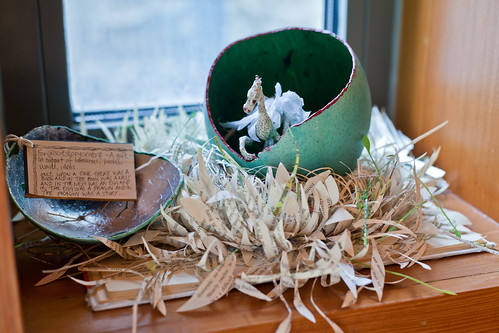
Continuing yesterday's theme on the magical world of words . . . Have you heard about the mysterious paper sculptures that have been left in various locations around Edinburgh? I just did, and the mysterious appearances have been continuing on for months!

The artist has been leaving them at locations that support "libraries, books, words, ideas," such as the Scottish Poetry Library, the Scottish Storytelling Center, and the Central Lending Library.

The "poetree" was left at the Scottish Poetry Library, with the note: "It started with your name @byleaveswelive and became a tree . . . We know that a library is so much more than a building full of books . . . a book is so much more than pages full of words . . . This is for you in support of libraries, books, words, ideas . . . a gesture (poetic maybe?)
Poetree, by Mysterious Book Sculptor with a Heart of Gold
Photographed by chrisdonia

My other favorite is the one that was left at the Scottish Storytelling Center, with the note: "For @scotstorycenter - A gift in support of libraries, books, works, ideas . . . Once upon a time there was a book and in the book was a nest and in the nest was an egg and in the egg was a dragon and in the dragon was a story . . .
Poetree, by Mysterious Book Sculptor with a Heart of Gold
Photographed by chrisdonia

For more pictures, visit Central Stn, where I first heard about these works of art.

Sunday, August 21, 2011

The Great Heart's Ocean


Dear mind, such a traveler, always moving
like a fish looking for the sea,
while the great heart’s ocean waits all around and outside it.
How can you live outside this love?
     —Rumi, trans. Coleman Barks


LinkWithin

Related Posts Plugin for WordPress, Blogger...