Showing posts with label gentleness. Show all posts

Thursday, January 24, 2013

Putting an End to Anger

by H. J. Ford for the story "The Comb and the Collar"

I want to share a sutra with you. It is the Discourse on the Five Ways of Putting an End to Anger, and I'm sharing it because it describes a process I have watched in myself. Maybe you will also find that you are practicing this already, or maybe you will be encouraged by what you hear. 

The full sutra is here, and it is relatively short. I think you will enjoy the story-like quality of the sutra. But if you want the short version, here is the fourth method:

"This is the fourth method, my friends. If there is someone whose words and bodily actions are not kind, and in whose heart there is nothing that can be called kindness, if you are angry with that person and you are wise, you need to find a way to meditate in order to put an end to your anger.

"My friends, suppose there is someone on a long journey who falls sick. He is alone and completely exhausted, and not near any village. He falls into despair, knowing that he will die before completing his journey. If at that point, someone comes along and sees this man’s situation, he immediately takes the man’s hand and leads him onward to the next village, where he takes care of him, treats his illness, and makes sure he has everything he needs by way of clothes, medicine, and food. Because of this compassion and loving kindness, the man’s life is saved. Just so, my friends, when you see someone whose words and bodily actions are not kind, and in whose heart there is nothing that can be called kindness, give rise to this thought: Someone whose words and bodily actions are not kind and in whose heart is nothing that can be called kindness, is someone who is undergoing great suffering. Unless they meet a good spiritual friend, there will be no chance for them to transform and go to realms of happiness. Thinking like this, you will be able to open your heart with love and compassion toward that person. You will be able to put an end to your anger and help that person. Someone who is wise should practice like this."
    —Discourse on the Five Ways of Putting an End to Anger


Thursday, June 7, 2012

Primary Speech

Walking in Sunrise, by Kristina Swarner
via Chemers Gallery

The concept of prayer has always been confusing to me. What does it mean to use a human language to speak to the divine? What could we possibly say to a divine being that would be of any consequence? For me, these are questions that I don't want an easy answer to.

Primary Speech, by Ann and Barry Ulanov, offered some new ground to explore on the subject of prayer. What I loved about their theology of prayer was where they located its beginning: the human desire to speak honestly about one's self. To me, this fits with the somewhat anthropological, psychological religion I'm drawn to. Don't we all, at times, want to be gently but firmly aware of who we are? 

From this point of "confession" comes illumination and unification—the identification with creation and awareness our interconnectedness. One of my favorite themes.

Although I think the Ulanovs would disagree, their concept of prayer feels like something that could be possible for people with vastly different concepts of God or no-God. To me, their minimal definition of prayer involves the meeting of self with a revelatory Other. 

"All that we would hold most dear and protect most earnestly is transmuted into our own bits of gold and frankincense and myrrh to bring to the child in us and the child outside us."

"We die to our own small versions of reality; we give into God's care our mythical gods and the gods of our personal and collective myths. These are the gifts we bring to our epiphany."
    —quotations from "Transfiguration," Primary Speech, by Ann and Barry Ulanov

Sunday, June 3, 2012

Spider Yoga

Spider Woman, by Man Ray

We moved into a new home about a month ago—a home that had sat empty for several years before we showed up. Spiders had decided to take up residence, and we still see a spider somewhere inside our home just about everyday.

When I see a spider, it isn't just a bug to me; I can't help think about the different roles that spiders have played in myths (grandmothers, seductive women, cursed humans, tricksters). I feel a little less powerful (and less mythological—there aren't any stories about me in mythology, are there?) when my path crosses these little guys. Sometimes they get smashed, I have to admit, but I try to let them be, when I can.

The other night a spider joined me for yoga. She had long thread-like legs, and she mostly walked upside-down on the window blinds. I found her to be a very good teacher. She was so graceful and so self-assured. 

So I tried to do spider yoga in her honor. This involved some balancing poses: sun salutations flowing into half-moon posewarrior three, and extended hand to big toe pose. With my arms and legs splayed out and floating in air, I tried to find the same quiet ease as the spider displayed. For me, this is when yoga is best—I'm not only deepening into my own breath and body, I'm also deepening into the mythological collective. 

Sunday, April 29, 2012

The Stories We Tell Ourselves

by J. J. Granville
via Little Hokum Rag

"Why do you look at the speck of sawdust in your brother's eye and pay no attention to the plank in your own eye?"
    —Matthew 7:3

Lately I've been thinking a lot about stories we tell ourselves, and the verse above keeps popping into my head. I feel like it has beautiful applicability to current postmodern concepts of personal narratives. 

There are times when I don't enjoy the stories other people tell about themselves. The stories seem so detached from the reality that I'm seeing. But then I remember that the stories I tell about myself are just as strange and unfathomable. So what can I do?

Surely there is a way to be gentle and loving that shows our friends the unexplored sides to the stories they tell. It probably doesn't do much good to get indignant about little mythologies (unless they're tending towards weirdo, evil delusions), because for the person who's telling them, these mythologies are true. If we are craving gentleness from others, it seems only kind to be gentle with others' stories.

And maybe we can open our own life story up to the contributing views of others. What do you think? Is it possible to allow someone else to share in the authorship of your life?

Thursday, April 12, 2012

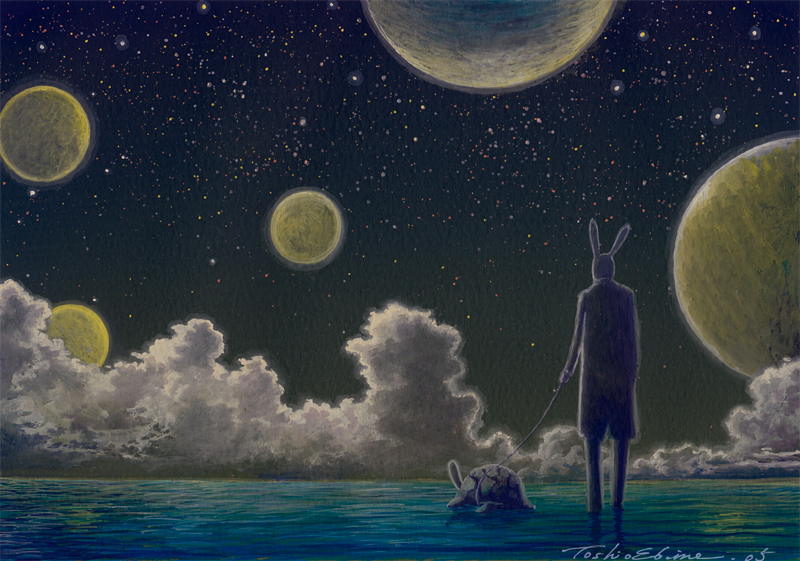
Doing Nothing

The Night before Footrace, by Toshio Ebine

"The Tao does nothing, yet leaves nothing undone."
    —Tao Te Ching, verse 37, Lao Tzu

Lately I've been doing everything, and leaving everything undone, so this little reminder of wu-wei is beyond helpful for me.  

For me this piece of wisdom specifically applies to my inner world, where I feel so tempted to fix everything and work to achieve a blissful, peaceful state of mind. But maybe I could let go of trying to work out every little problem. Maybe I could just go on with my life and live it well, and then maybe things would naturally come into alignment. 

Tuesday, February 7, 2012

The Way of the Bodhisattva

"Bathers," by Georges Barbier?
via Orbs of Zenith, via mpt. 1607

"When you look at others think
That it will be through them
That you will come to Buddhahood.
So look on them with frank and loving hearts."
    —The Way of the Bodhisattva, Shantideva

There must be thousands of opportunities to do this in a single day; maybe I can choose to do this just once!

Tuesday, January 24, 2012

Messy, Alchemical Art

Sugar Bowl, by Adele Shaw
via Inclusions Gallery

I met Adele Shaw at a museum I visited in San Francisco years ago. I remember thinking how amazing it was to talk to an artist about her work and how important it was to not say anything stupid. I remember her smiling.

At the time, she was working on a project called "oology." Luckily I've saved my postcard, because I can't find images online anywhere. I thought it was beautiful work; I still love how embodied and playful it is, and how delicate it is, too.

Scanned postcard from Adele Shaw's "oology" exhibit

Now it seems she works mainly on canvas, but still with beeswax. In her own words:

"My painting is a influenced by the power of nature and inspired by the chaos of people’s chronic search for order, space, and story. 

I paint first with water colors, then with encaustic paint, layers of hot beeswax, pigment and resin. I coerce it onto paintings as a hot, drippy, excitable mess. . . . 

Encaustic painting is an alchemical process of extreme versatility. It is both additive and subtractive. It can be painted, sculpted, or moulded. Between the layers the process is quite unpredictable."

Sunday, January 8, 2012

How to Be a Good Pine Tree

The Last Gleam, by Charles Warren Eaton

Sometimes we just need a simple reminder:

"Imagine a pine tree standing in the yard. If that pine tree were to ask us what it should do, what the maximum is a pine tree can do to help the world, our answer would be very clear: 'You should be a beautiful, healthy pine tree. You help the world by being your best.' That is true for humans also. The basic thing we can do to help the world is to be healthy, solid, loving, and gentle to ourselves. Then when people look at us, they will gain confidence. They will say, 'If she can do that, I can do that too!'

"So anything you do for yourself, you do for the world. Don’t think that you and the world are two separate things. When you breathe in mindfully and gently, when you feel the wonder of being alive, remember that you’re also doing this for the world. Practicing with that kind of insight, you will succeed in helping the world. You don’t even have to wait until tomorrow. You can do it right now, today."

    —excerpt from "Imagine a Pine Tree," an interview with Thich Nhat Hanh, Shambhala Sun, January 2012

Sunday, December 18, 2011

Singing to Pain

Orpheus, by Odilon Redon
via Orbs of Zenith

Apparently I'm in a musical mood these days. The subject for today: musical therapy, which I first heard about from a friend, who literally sings to the parts of her body-soul that are in pain. She says it opens up those areas to "flow" and releases stagnation.

Then, I heard a segment on Talk of the Nation about musical therapy. The part that I found fascinating was a therapist who modified the stressful hospital environment by improvising melodies on the guitar, in response to the sounds of the hospital. What creativity! And he also improvised melodies in response to the patient's reaction. What compassion! 

In what areas of your life would you add song? What would you sing? What melody would you play?

Tuesday, December 6, 2011

Postmodern Hymn: That I Would Be Good


Let's allow Alanis to break it down for us. If you're like me, you've probably heard "That I Would Be Good" before, but it still grips me when I hear it. She has a way of naming internal realities with such clarity.

I've been thinking about self-love lately and how to avoid the pitfalls of the selfish form of love Westerners can be so good at. I don't pretend to have it all figured out, but here are my thoughts:

Looking at common depictions of self-care, I find them very superficial. Take a picture of your body and call it accepting your body. This kind of practice seems very alienating to me. I know that when I'm happiest in my body, it is because I am enjoying the sensations of moving, breathing, and resting. The times when I feel the most self-love are when this feeling of body awareness deepens into a sensation that at the core of my being, all is well, and all is accepted. There is a softening, a loosening of resistance, to my struggles. I suspect that some thinkers might find some of these things weak and reprehensible. But I think the process of becoming gentle with oneself, in the way I've just described, resonates with what Alanis is singing about, as well as with what teachers like Pema Chodron advocate.

So, this is my invitation to allow your pleasurable practices of the body to penetrate to your core, and to love the body-heart-mind-soul mystery as you encounter it.

Tuesday, November 22, 2011

Walking Meditation

Maiden Crone, by Bonnie Wildwood

The great teacher Thich Nhat Hanh suggests that we try walking meditation while holding the hand of a child.

I would also suggest visiting an elderly relative or friend and walking with them. I visited my grandmother this weekend, and going at her pace, stopping with her to smile at the people we passed by, and remembering that growing old and frail is a natural part of life were all great lessons for me. 

Tuesday, November 1, 2011

Early to Bed

Sleeping Beauty, by Roberto Innocenti
via Fairy Tale Mood

I'm a night owl. If I could, I would stay up later and later each night, because my internal clock seems to have thirty hours in a day instead of the real twenty-four. The truth is, I can never quite believe that I've done enough in a day. Thus, I'm beginning a new practice—intentionally going to bed early—to affirm that I've spent my day well and that all I can do is honor each moment as it comes.

Friday, September 2, 2011

Whooo are youuu?

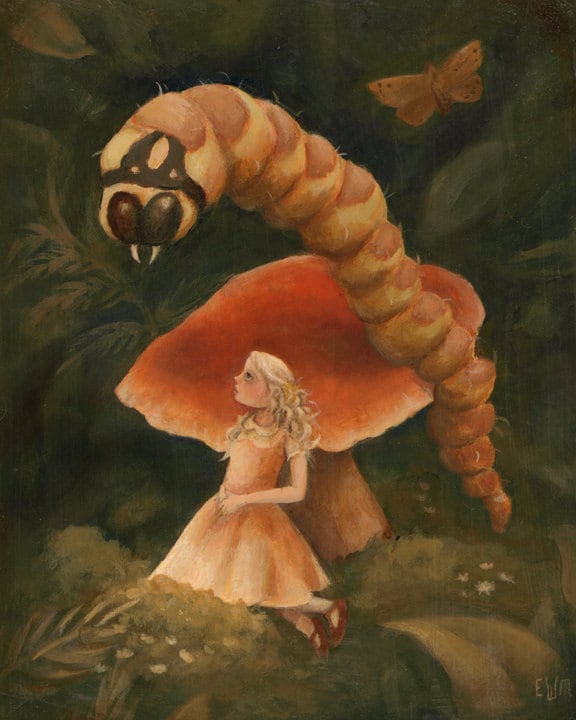
The caterpillar asks Alice, "Who are you?"
Alice and the Caterpillar, by the Emily Martin, aka the Black Apple


I came across a lovely article by Anne Lamotte on Oprah's website (via Medicinal Marzipan).

I love that Anne describes the process of coming to live authentically as an often messy, embarrassing, painful process. Because if you're really wanting to see transformation, it's going to take courage.

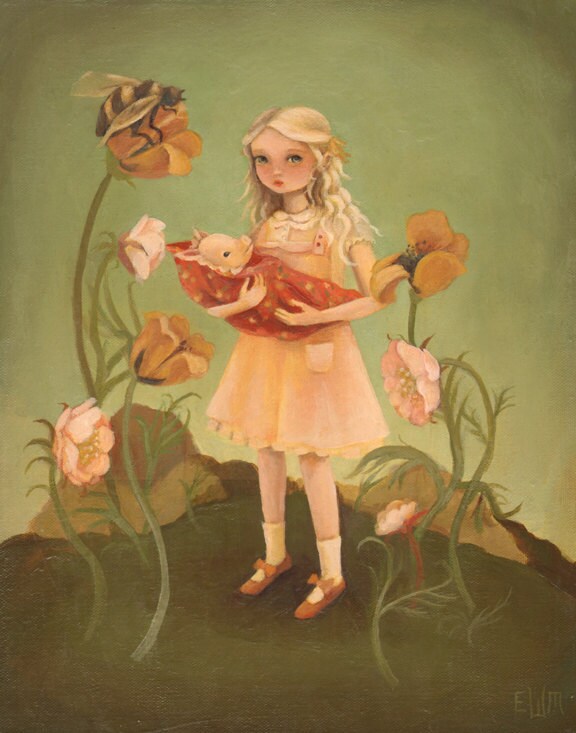
Alice and the Piglet, by Emily Martin

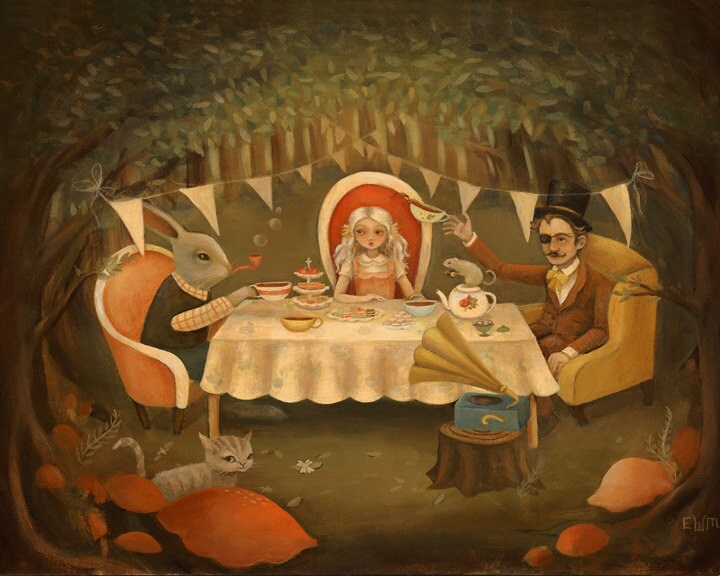
The Mad Tea Party, by Emily Martin

Read the whole article; it's so worth it! And then ponder the last two sentences with me, because they're too poetic to not become a sort of mantra:

"To love yourself as you are is a miracle, and to seek yourself is to have found yourself, for now. And now is all we have, and love is who we are."

Still Life with Live Flowers, by Emily Martin


Tuesday, August 23, 2011

Vulnerability


El Corazon, by Elsa Mora

I watched a fantastic video on TED today, on vulnerability, which reminded me of a major theme that Pema Chodron speaks about—the beautiful act of opening our hearts to others and to life. I'll let her say it in her lovely eloquent way:

"When you begin to touch your heart or let your heart be touched, you begin to discover that it's bottomless, that it doesn't have any resolution, that this heart is huge, vast, and limitless. You begin to discover how much warmth and gentleness is there, as well as how much space."
    —Start Where You Are, page 126, via lotus in the mud

Girl in Heart House, by Elsa Mora 


LinkWithin

Related Posts Plugin for WordPress, Blogger...